Voice Widget vs Chatbot: Which Converts More?
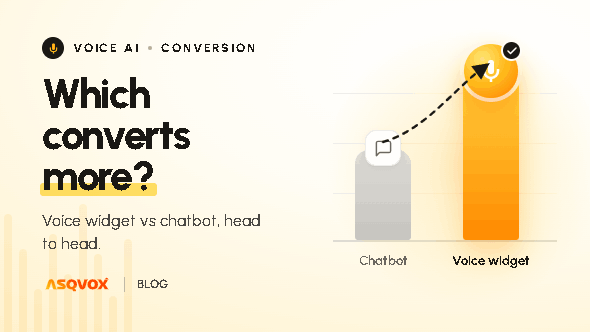
A chatbot makes your visitor type out their question and hope the canned reply fits. A voice widget lets them just talk, the way they would to a salesperson in a store, and get the exact thing they came for. AsqVox's Orb is voice-first, with a text mode for when talking isn't an option, it activates on the visitor's intent, and it answers from your own content. Here's how the two compare, and where each one fits.
Who's weighing a voice widget against a chatbot
Most people asking this already have a chatbot, or they're about to add one, and something keeps nagging them toward voice instead. The nagging is usually the same: text chatbots often don't help the visitor find a relevant answer, and texting itself is cumbersome. A visitor lands wanting a quick understanding of the site, the products or services, or simply how to get in touch, and they don't want to click into a page and wade through content to get it. The chatbot, more often than people admit, won't give an accurate answer even after they've asked a few times.
Sitting behind that is a harder truth for the website owner. You've put in hours, and real money, to get a visitor onto the site. But once they're there, you can't actually communicate with them. That gap is where the interest in voice comes from, and it's why a website owner, a CRO specialist or a CMO trying to capitalise on the traffic they already paid for tends to pay attention.
The core difference: a chatbot makes them work, voice is like a salesperson
Think about walking into a good retail store. Someone notices you, walks you to the right product, helps you understand whether it fits, and answers as you ask. You don't read signs and dig through shelves; you just talk, and they handhold you to what you came for.
That's what we mean by "like a salesperson," and it's the whole idea behind the Orb. A chatbot puts the work back on the visitor: type the question, read the menu of canned options, re-type it when it misreads you, wait. The Orb removes that. The visitor speaks the way they naturally would in a store, and the widget assists them the same way a salesperson would in person, which is what lifts conversions and the intangibles around them too, brand value, brand likability.
Why this matters more now than it did a year ago
Getting a visitor onto your site has only got harder. People now get their answers straight from ChatGPT, Perplexity and AI overviews, often without ever clicking through to a website at all. So the visitor who does land on your page is rarer and more valuable than they used to be, and they usually arrived with a real intent, something specific they want to know or do.
Handing that hard-won visitor a text box and a set of canned replies is a poor return on everything you spent to get them there. They want the exact thing they came for, quickly, and a chatbot that misses the query after two or three tries doesn't give them that.
Why voice changes how visitors behave
There's a quieter reason voice works, and it's worth sitting with for a second. When someone reads and types, really only one sense is doing the work, the eyes. Add voice and you bring in another channel, and engagement tends to rise with it. A different lens on it, but a fairly psychological one once you look.
Texting became the default mainly because, before software got this intelligent, it was the only option, so we still reach for it out of habit. That's starting to shift. The rise of dictation-first tools, Wisprflow and others, is a market signal worth reading: people are choosing to speak rather than type for their emails, their prompts, their documents, even some of their code, because speaking carries less friction than typing.
You can see that friction difference in how people actually behave. Most visitors won't type at length; they keep their messages short and clipped, mindful of the effort. On voice that restraint falls away, because speaking costs them less energy, so they say what's actually on their mind, in full. You end up hearing the visitor's real intent rather than a trimmed-down version of it, which tells you far more about what they need and how to win them.
And the widget is there the whole time. No working hours, no leaves, no waiting for someone to come online. A visitor at midnight gets the same salesperson a visitor at noon does. By the time that visitor does reach out to your business directly, they've already learned a lot from the widget, so it tends to be a high-intent conversation rather than a basic query, someone closer to deciding than just asking.
What the Orb does that a text chatbot doesn't
It doesn't wait to be clicked. A chatbot sits in the corner until someone opens it. The Orb reads what the visitor is doing and steps in on its own, when they're about to leave the page, when they've scrolled past around half of it, or after a few seconds of dwelling, the moments they're most likely to have a question or be about to drop off.
It answers from your actual content. A lot of the distrust people carry for chatbots comes from being handed confident answers that turn out wrong. The Orb works on retrieval. You upload your content, a text file, a doc or a PDF, we summarise it into .md files the agent pulls from in real time, and it answers from your knowledge base and nothing else. So when the thing a visitor wants sits two or three clicks deep in your site, the Orb takes them straight to it instead of making them hunt, and it does that accurately because it isn't improvising.
It still does text when talking isn't an option. Voice is the point, but the widget has a text chat mode as well, so a visitor on a quiet train or in an open-plan office isn't shut out. They pick whatever suits the moment.
It reads the tone, not just the words. The dashboard gives you transcripts and recordings like a chatbot would, and on top of that it reads whether each conversation felt positive, neutral or negative, so you can see how visitors felt, not only what they asked.
When a plain chatbot is genuinely fine
We're not going to pretend voice wins every single time. If your site is small and simple, and all you really want is to deflect a handful of basic questions, your hours, your address, a returns policy, a plain text chatbot does that at minimal cost and setup, and that's a perfectly reasonable choice. Some visitors also just prefer to quietly click through options without talking. For the simplest needs, you don't need much more than a basic bot, and we'd rather say that than oversell.
When the Orb is the better call
The Orb earns its place the moment your site is doing real work. When you've paid to get traffic onto it and you want to convert that traffic. When the things visitors want sit deeper than the homepage. When the visitor arrived with genuine intent and wants a real answer fast. If you're a website owner, a CRO specialist or a CMO trying to make the most of traffic you already worked and paid for, that's exactly the situation the Orb is built for. It talks to that visitor the way your own salesperson would, gets them to what they came for, and is there to do it every hour of every day.
Getting started
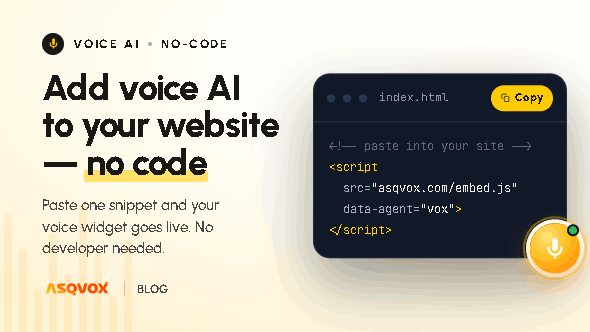
Setup is built for someone non-technical, with no developer needed. You follow a short guided flow, and it ends with a single script tag you paste onto your site. Because the Orb does both voice and text, one widget can stand in for the chat box you're replacing, and you can run a separate widget per page, each with its own knowledge base and tone, so the pricing page, the docs and a landing page each get the right agent. For the full walkthrough, see how to add voice AI to your website.
Frequently asked questions
Is a voice widget better than a chatbot?
It depends on what your site needs to do. For deflecting a few basic FAQs on a simple site, a chatbot is fine. For converting traffic you've paid to earn, where visitors arrive with real intent and want deeper answers fast, voice does the job a chatbot can't.
Can visitors still type if they don't want to talk?
Yes. The widget has a text chat mode, so anyone who can't or would rather not speak can type instead. It's voice-first, not voice-only.
Will it give wrong answers the way chatbots sometimes do?
No. The Orb retrieves from the knowledge base you upload and answers from that content only, rather than improvising, so it stays grounded in what's actually true about your business.
Do we need to keep a separate chatbot alongside it?
No. Because the Orb does both voice and text, it can take the place of a text chatbot rather than sit next to one.
Does it work outside business hours?
Yes. It's available every hour of every day, with no working-hours limits and no one to wait for.
How does it know when to start a conversation?
It activates on the visitor's behaviour, when they're about to leave, when they've scrolled past around half the page, or after a few seconds on it, as well as on a normal click.
Is it hard to set up?
No. Onboarding is built for non-technical users, and you're live in a few minutes from a single script tag.