Chat Is Dead: The AI-Search Era Killed the Text Box
Chat isn't dead as an idea. What's dead is the passive text box that sits in the corner of your site waiting to be clicked. AI search has gutted the traffic that used to feed it, the visitors who still reach your site are rarer and arrive with far higher intent, and converting them now means talking to them at the moment of intent, not waiting for them to type. This is the case for voice as the conversion layer of the post-search web.
The thing that died wasn't chat. It was the traffic model under it.
For fifteen years the deal was simple. You wrote content, you ranked, people clicked through, and a slice of them converted. The text chat widget in the corner made sense in that world, because there was a steady river of visitors flowing in, and catching even a small fraction of them was worth it.
That river is drying up, and the numbers aren't subtle. By 2025, roughly 60% of Google searches ended without a single click to any website, according to Similarweb. Inside Google's AI Mode, Semrush put that figure at 93%. When an AI Overview appears on a result, Seer Interactive found organic click-through collapses by about 61%. And AI Overviews are no longer an edge case, BrightEdge measured them on close to half of all searches by early 2026.
The downstream effect on real businesses is brutal. Bain & Company estimated organic web traffic has fallen 15 to 25% across many sectors as a direct result, and reported that most consumers now lean on AI-generated answers for a large share of their searches. Publisher traffic from Google dropped by around a third in the year to late 2025. Some well-known sites lost the majority of their organic traffic outright.
So the first thing to be honest about is this: the passive text box didn't fail because it was a bad tool. It's being starved. The visitors it was built to catch are getting their answers from ChatGPT, Perplexity and Google's own AI before they ever land on a website.
The visitor who does reach you is a different person now
Here's the part most people miss while they're mourning the traffic. The visitor who survives that funnel and actually arrives on your site is worth far more than the average visitor used to be.
They're rarer, they arrive later in their thinking, and they've usually already done their research in an AI tool before they got to you. That shows up in the conversion data: AI-referred visitors have been found to convert several times better than standard organic visitors, precisely because they turn up already informed and closer to a decision. Bain also reported that the overwhelming majority of B2B buyers now purchase from a shortlist they'd formed before they ran a single search.
Put those two facts together and the picture is clear. You get fewer visitors, each one cost you more to earn, and each one shows up further down the path to buying. Every visitor is now high-stakes. Wasting one is a much more expensive mistake than it was three years ago.
Why the text box fails this new visitor
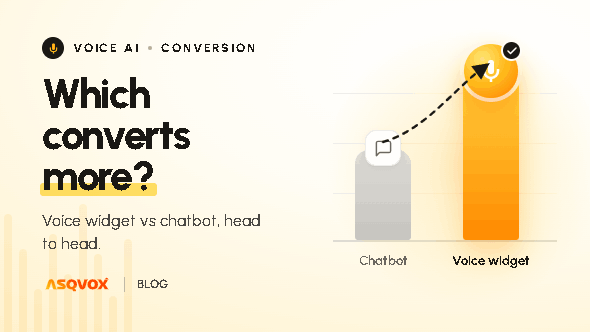
This is where we have to be precise, because the lazy version of this argument is wrong. Text chat does convert. For visitors who actually engage with it, chat converts somewhere in the 10 to 20% range, and it has been shown to beat static forms by three to five times for high-intent leads. Chat works. That's not the problem.
The problem is everything that happens before the engagement. A text box sits there and waits to be clicked, and most visitors never click it. A common benchmark for the share of visitors who open the widget at all sits around 12%. So even a chat that converts brilliantly is only ever working on a small slice of the people on your page. In the old world, with a fat river of traffic, that was a fine trade. In a world where every visitor is rare and high-intent, leaving the other 88% to read a page and quietly leave is the whole game lost.
And there's a second failure. Typing is friction. A visitor with a real question has to stop, frame it in words, type it out, and wait, and plenty of them simply won't bother. The box assumes the visitor will do the work to start the conversation. The new visitor, the precious one, often won't.
What the moment actually demands
If every visitor is rare and high-intent, two things follow, and they're not opinions, they fall straight out of the data above.
First, you have to engage actively, at the moment of intent, rather than waiting to be summoned. Even the chatbot industry's own best practice has quietly moved here: the guidance now is to trigger on behaviour, when a visitor scrolls deep into a page, pauses on pricing, or shows exit intent, not to sit passively in the corner. Waiting is the thing that's obsolete, not conversation.
Second, you have to remove the friction of starting that conversation, and the lowest-friction interface humans have is their own voice. People don't have to learn it, frame it, or type it. They just talk.
Why voice, and why now
Voice as an interface stopped being a novelty somewhere in the last two years, and the signals are everywhere if you're looking.
People are choosing to speak over typing in growing numbers. Surveys put the share of consumers doing daily searches by voice at around a third, with the main reason given being simple speed and convenience. The money is moving the same way: venture investment into voice AI jumped from roughly $315 million in 2022 to around $2.1 billion in 2024, close to a sevenfold rise in two years. And the behaviour shift is now being documented in serious research. A study from the London School of Economics with Jabra predicted that voice will be the mainstream way of working with generative AI by 2028, found that a meaningful slice of knowledge workers already prefer speaking to typing, and measured a notable rise in trust when people spoke their commands rather than typed them.
There's a human reason underneath the numbers, too. When someone reads and types, really only one sense is doing the work. Add voice and another channel comes into play, and engagement rises with it. People also say more when they speak. Most visitors keep their typed messages short and clipped, mindful of the effort, but on voice that restraint falls away, because speaking costs them less. You end up hearing what the visitor actually wants, in full, rather than a trimmed-down version of it. For anyone trying to convert that visitor, hearing their real intent is worth a great deal.
So what replaces the text box
Not a better chatbot. A different surface.
The conversion layer for the post-search web is voice that meets the visitor at the moment of intent, on the page they're already on, answering from the business's own content. That means three things working together: it activates on the visitor's behaviour rather than waiting for a click, it lets the visitor speak instead of type, and it answers accurately from what's actually true about the business rather than improvising.
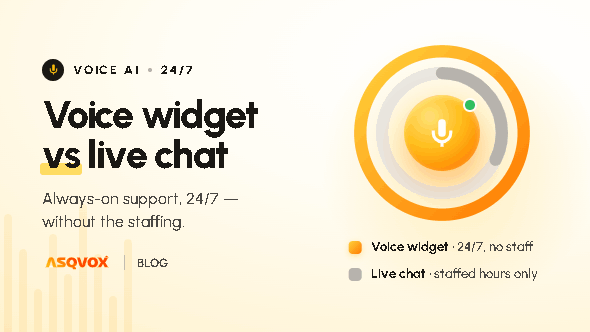
This is what we're building at AsqVox. The Orb is a voice widget that steps in when a visitor is about to leave, has scrolled halfway down, or has lingered a few seconds, that lets them simply talk, and that answers strictly from the business's own knowledge base. When talking isn't an option, it has a text mode, because the point was never to ban typing, it was to stop forcing it. It's the same instinct a good shop has: notice the customer, walk over, and help them to the thing they came for, rather than leaving them to wander the aisles and hope.
The honest version of "chat is dead"
Chat as a concept didn't lose. Conversation won, completely, that's the whole reason AI search is eating your clicks in the first place.
What died is the form chat took for the last fifteen years: a passive, text-only box, sitting in the corner, waiting for a visitor to do the work of starting. That model was built for a web with traffic to spare and visitors with time to type. Both of those assumptions are gone. The web is turning into a conversation, the visitors who reach you are fewer and more valuable than ever, and the businesses that win them will be the ones that actually talk to them.
That's not the death of chat. It's the start of something that was always going to replace it.
A note on the data: the figures above are drawn from third-party research current to early 2026 (Similarweb, Semrush, Seer Interactive, BrightEdge, Bain & Company, the London School of Economics with Jabra, and others). Before publishing, link each figure to its primary source and confirm it's the latest available. The next version of this piece will replace borrowed data with our own, conversion lift measured across live deployments, which is the version that turns this argument from a well-argued case into a primary source others cite.